
How to Learn Berimbau: A Beginner’s Guide to Brazil’s Most Fascinating Instrument
Are you wondering how to learn berimbau? If you’ve ever watched a capoeira roda (circle), chances are the berimbau was one of the first things that caught your attention. With its curved wooden bow, resonating gourd and distinctive sound, the instrument seems to belong to a world of its own. For many people, hearing a berimbau for the first time is a memorable experience. Playing one for the first time can be even more surprising.
But the berimbau is much more than a musical instrument. It is the heart of capoeira music, the instrument that guides the roda and helps shape one of Brazil’s most important cultural traditions. That is why learning to play it is not only about developing musical skills. It is also an invitation to explore Brazilian history, Afro-Brazilian culture, rhythm, community and storytelling.
“If I had to associate the sound of the berimbau with something,” says Jorge Hernández, a berimbau teacher and capoeirista with more than a decade of experience, “it would be ancestry.”
That sense of connection is part of what makes the instrument so fascinating. As students learn to play, they also discover the stories behind the berimbau, the history of capoeira, the songs that have been passed down through generations and rhythms that shape everyday life in Brazil.
The reflections in this article come from a conversation I had with Jorge, who teaches berimbau in English, Spanish and Portuguese, both online and in person in Rio de Janeiro. Throughout the guide, you’ll find his insights on learning the instrument, developing rhythm, understanding capoeira and exploring the cultural traditions that surround the berimbau.
You might also like these articles:
How to Learn Brazilian Portuguese
Brazil Travel Tips: Insider Advice
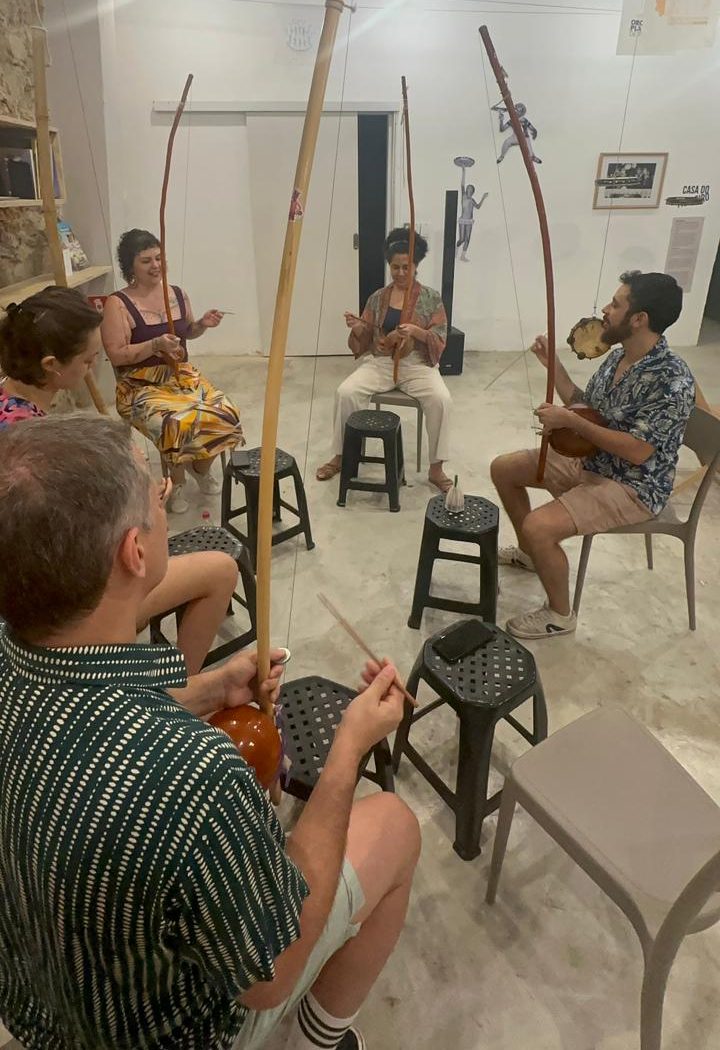
What makes berimbau such a unique instrument?
I think the first thing that catches people’s attention is just how different the berimbau is from most instruments they know. Its shape, the way it is held and played, and even the sound it produces are quite unlike what most people are used to seeing or hearing.
The berimbau is built from three main elements: a curved wooden bow, a steel string and a gourd. The string is tensioned by the curve of the wood, creating the instrument’s characteristic bow shape. The gourd acts as a resonating chamber, amplifying the sound in much the same way that the body of a guitar does.
In the same hand that holds the instrument, the player uses a stone or a coin (known as a dobrão) to press against the string and change the pitch being produced. It is this combination of movements that allows the berimbau to create different sounds and rhythms.
When people first start playing, they are often amazed to discover that they can already produce some sounds from the instrument. Little by little, they begin to understand how the vibration of the string, the position of the gourd and the pressure of the stone work together to create the berimbau’s distinctive voice.
This often leads to a moment of fascination, because the instrument appears simple at first glance, yet reveals a much richer range of sounds once someone begins to explore it.
For me, one of the most beautiful things is watching someone play the berimbau for the first time. Seeing that connection is very special. People are often visibly surprised, their eyes wide open as they try to make sense of what they are hearing and feeling in that moment.
If I had to associate the sound of the berimbau with something, it would be ancestry. When I listen to the instrument, I feel as though it transports me somewhere else. There is something very deep and difficult to explain in that sound.
Why is the berimbau so important in capoeira?
The berimbau plays a fundamental role in capoeira. It is the instrument that leads the roda and sets the tone for the game. Depending on the rhythm being played, certain things will happen inside the roda and others will not.
A capoeira roda usually includes three berimbaus, although this can vary depending on the style and traditions of each group. Some rodas may have only one or two. In general, however, there is one lead berimbau that guides the rest of the musical ensemble. All the other instruments join in and play according to what that berimbau is doing.
Because of this, the berimbau is much more than a musical instrument: it gives direction to the ritual of the roda. It establishes the context and helps guide the interaction between the players. Without the berimbau, it is difficult to imagine the roda unfolding in the same way. Its importance within capoeira is truly central.
From a Chilean capoeira student to a berimbau teacher
I first came into contact with the berimbau in 2013, when I started practicing capoeira more consistently. I had already had a brief introduction to it earlier, because my physical education teacher at school was a capoeirista and he had the great idea of including a capoeira unit in our classes.
I really enjoyed the experience, and by coincidence, when I started university, I found a capoeira group there. That’s where I began learning more seriously, and I never stopped. Since then, I’ve spent the last 13 years playing the berimbau.
People often asked me how to learn berimbau. When I first started, there was far less material available online. Most of the videos on YouTube were low quality and not meant for teaching. They were usually recordings of capoeira rodas or groups of people playing together, without any explanation of the rhythms, techniques or fundamentals of the instrument.
As a result, learning depended much more on direct observation and spending time with other capoeiristas. The community played a fundamental role in my learning process. Capoeira is a deeply social art form.
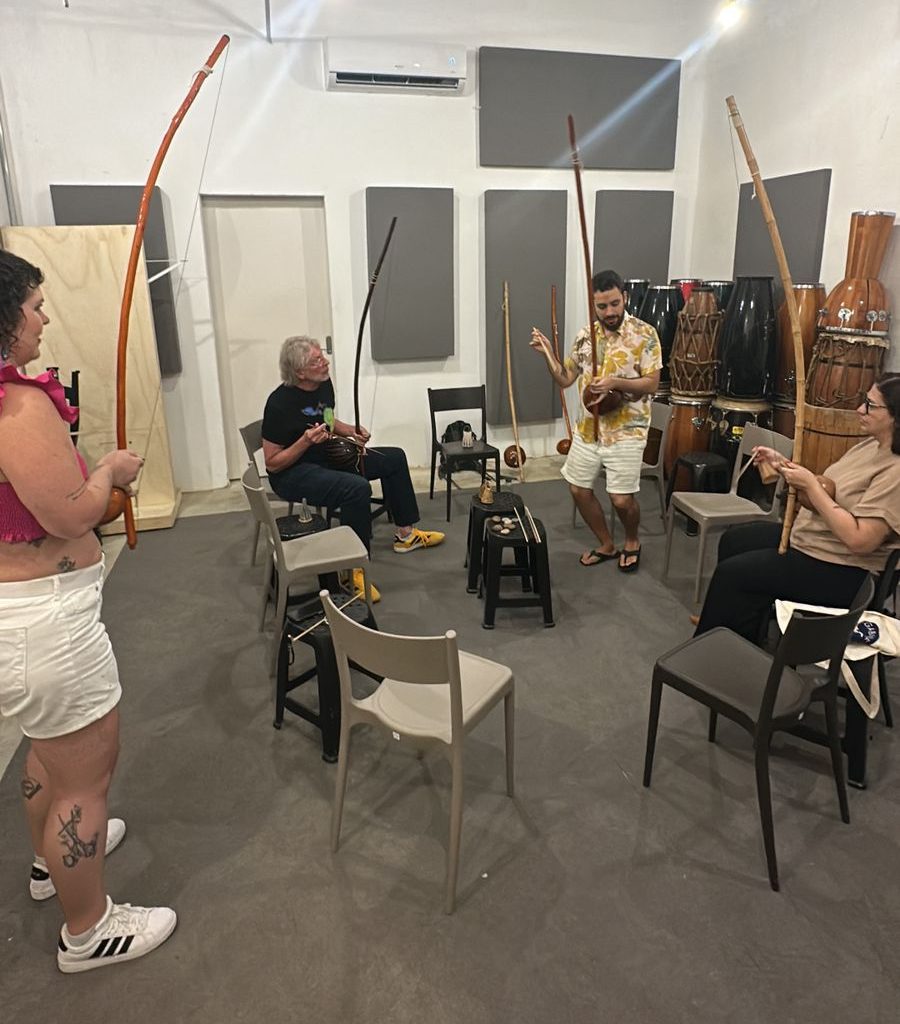
How to learn berimbau? Is it hard?
I’ve had the opportunity to teach berimbau in Brazil to people from very different backgrounds. Some students had never had any contact with the instrument or with music in general. Others had practiced capoeira as children and carried a long-standing curiosity about, or admiration for, the berimbau.
I believe the berimbau presents the same kinds of challenges that any instrument does for beginners. There are postures and movements that may feel uncomfortable at first, and it takes time for the body to adapt. But one of the most beautiful things about being a beginner is learning to deal with those difficulties and understanding that they are part of the process.
That’s why I believe having guidance along the way makes a big difference. A teacher can help direct the learning process and keep students motivated when challenges arise.
How long does it take to learn berimbau?
The answer varies greatly from person to person. There is no single timeline or formula that works for everyone.
What I consider most important, especially for beginners, is that students leave their very first lesson already able to play something. They need to experience the instrument, produce sounds and begin building a connection with it from the start. Without that practical experience, it becomes harder to stay motivated and continue learning.
The initial goal is not perfection but to develop a relationship with the instrument and to discover that learning it is possible.
Learning berimbau as a beginner
I like to begin by introducing the instrument from a broader perspective. We talk about how the berimbau is built, the materials it is made from and the way it produces its sounds.
I also believe it’s important to explore its history. We discuss the origins of the instrument, its journey to Brazil and the deep relationship it developed with capoeira over time.
Alongside the historical and cultural aspects, I focus on the student’s first practical experiences with the instrument: posture, producing the basic sounds and learning the fundamental movements that allow beginners to start playing and exploring the berimbau from day one.
Can you practice berimbau alone at home?
Yes, absolutely. What I usually do with my students is provide support materials such as videos, recordings and reference audio tracks so they can continue practicing between lessons.
In the beginning, I think it’s very important for students to practice with some kind of reference. This helps them recognize when a movement is being performed correctly and when something needs adjustment. Having that support makes learning easier and gives beginners more confidence.
As students develop a solid foundation and become comfortable with the fundamental sounds and movements, their practice can become more exploratory and creative. But at first, I prefer to build a strong base of knowledge so they can understand how the instrument works and how to produce its different sounds. To do this, I mainly use traditional capoeira rhythms.
What if someone thinks they have no rhythm?
This is a very common concern from students wondering how to learn berimbau. Many people believe that rhythm is something you’re either born with or you’re not. But my experience has shown me that it doesn’t work that way.
Of course, some people may have more natural ease than others, but in general, rhythm is something that can be developed and trained. It has a lot to do with the experiences and stimuli we’ve received throughout our lives, as well as what we continue to practice and learn. After all, we never stop learning.
For students who struggle with rhythm, I often use exercises that involve the body itself to help them understand capoeira’s rhythmic patterns. When rhythm is experienced physically, it becomes easier to understand and internalize. People stop simply thinking about rhythm and begin to feel it.
Another recommendation I often make is to complement learning the instrument with other activities that develop rhythmic awareness. This can involve another musical instrument, but it can also be something like dance.
What are the most common mistakes beginners make?
I think the most common mistake is expecting to get everything right on the first attempt. This isn’t unique to the berimbau—it applies to learning any instrument. That’s why I believe one of the most important tasks for beginners is learning how to persist when things don’t go as planned. Learning music requires patience.
When I teach beginners, my main focus is to provide clear information, demonstrate movements in a simple and understandable way, and help students manage the anxiety that often appears during the learning process. Some people want to learn very quickly and become frustrated when they realize that meaningful progress takes time.
We’re currently used to seeking immediate results, but learning an instrument reminds us that some things can only be developed through dedication and practice. To deepen your understanding, you need to spend time with the instrument, explore its possibilities and build knowledge gradually. That isn’t an obstacle—it’s an essential part of the experience.
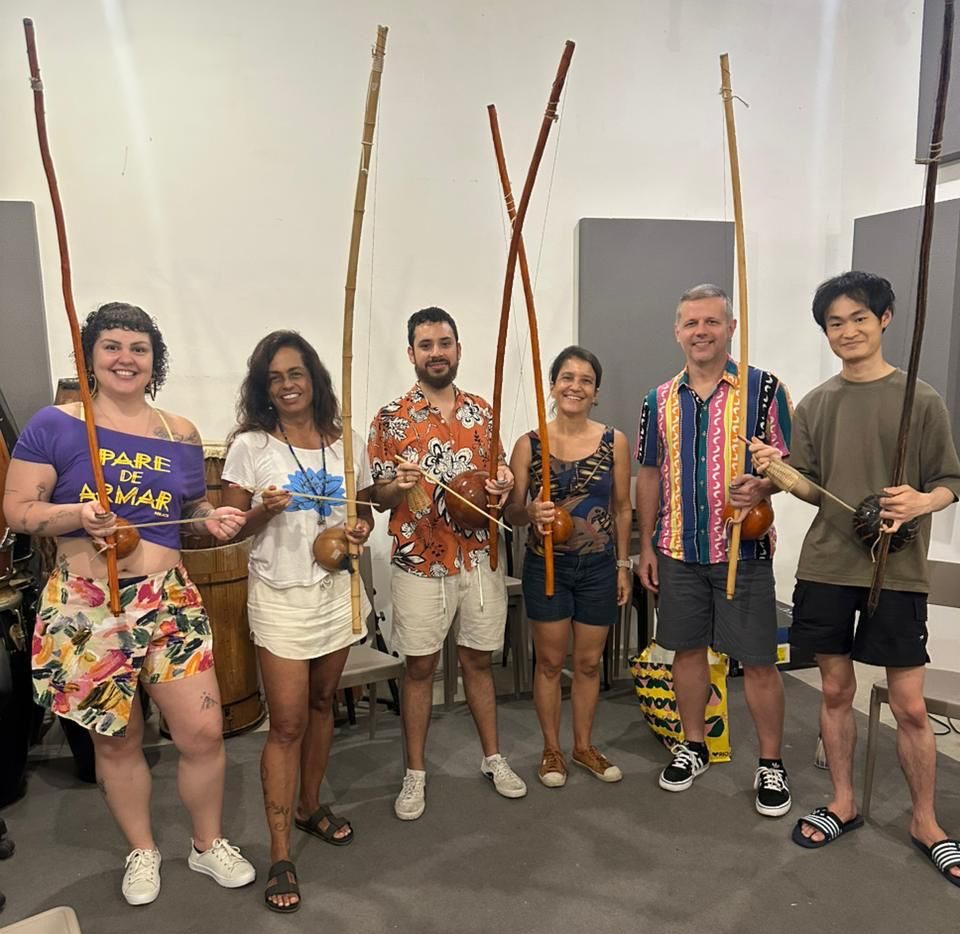
What can berimbau teach you about Brazilian culture?
What I find particularly interesting is that, unlike what happens in many lessons for other instruments, the historical dimension is not optional or secondary. In the case of the berimbau, it is deeply integrated into the learning process.
The berimbau is so closely connected to Brazilian history and culture that studying the instrument naturally leads you to explore its broader context. This includes understanding how it arrived in Brazil, its connections to slavery and to African and Afro-Brazilian communities, as well as its central role in the development of capoeira.
Another important aspect is that, at a certain point, students begin to sing and play at the same time. This leads to the study of capoeira songs, whose lyrics tell stories, describe everyday experiences and refer to people, places and historical events. In many ways, these songs serve as a portrait of the lives of the people who created and kept this tradition alive.
It is also common to study the great references of capoeira—the mestres and mestras who helped shape its history. For this reason, learning the berimbau opens many doors to understanding important aspects of Brazilian culture and history.
Is music a way to discover Brazil beyond its touristattractions?
Absolutely. Brazil is a country of continental dimensions and enormous cultural diversity. Each region has its own rhythms, traditions and musical expressions. By exploring these different musical traditions, it becomes possible to appreciate the country’s richness in a much broader way than by simply studying historical dates or isolated events.
History is important, but music offers something more: it allows you to feel the culture. It doesn’t merely transmit information—it conveys emotions, memories, values and ways of seeing the world.
Music is also deeply present in the everyday lives of Brazilians. Brazil has an exceptionally strong music industry, and one interesting characteristic is that most of the music consumed by the population is produced within the country itself.
In many ways, music reveals aspects of identity, daily life and collective memory that often remain invisible in more traditional approaches to history and culture. It can even help us understand the rhythm of people’s lives. Not only musical rhythm, but the way they celebrate, gather, tell stories and express emotions.
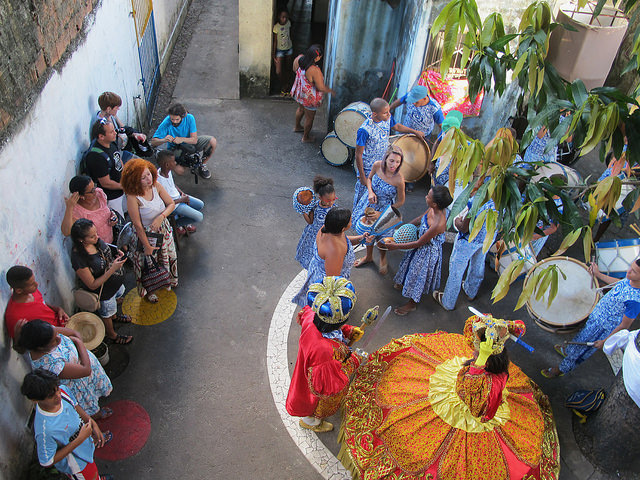
Why learning rhythm can change you beyond music
One of the main skills developed in berimbau lessons is rhythmic awareness. In my classes, we work on understanding the rhythmic cycles found in both music and capoeira, using traditional berimbau rhythms as the foundation for that learning process.
Students develop coordination, musical listening skills and a deeper understanding of rhythmic patterns. Over time, this knowledge can also be applied to other Afro-Brazilian rhythms and musical traditions.
Yet the impact of rhythmic awareness extends far beyond the instrument itself. As we become more conscious of rhythm, it becomes easier to follow a song, identify its pulse and play together with other people. This understanding creates a much deeper connection to the musical experience.
But in my experience, the effects go far beyond music. Over time, you begin to notice rhythm in many aspects of everyday life. You start paying attention to the rhythm of the way people walk, work, speak and interact. Sometimes you even realize that you tend to walk at the same pace as a family member or someone you spend a lot of time with.
Developing rhythmic awareness expands the way we perceive the world around us. It’s almost as if we learn a new way of observing patterns that were always there but previously went unnoticed.
How to learn berimbau in Rio de Janeiro
Rio de Janeiro is a city where music is everywhere. It’s easy to find samba, choro and pagode gatherings taking place in different neighborhoods. And because it brings together people from all over Brazil and around the world, it’s also possible to encounter cultural traditions from many other regions of the country.
You can find forró gatherings, coco rodas, frevo performances, carimbó groups, boi-related traditions and many other forms of Brazilian cultural expression. Of course, these traditions take on different characteristics outside their regions of origin, but they still offer an excellent opportunity to experience Brazil’s cultural diversity.
Another aspect I love is the city’s relationship with public spaces. Squares, parks and beaches are frequently used as gathering places for musicians, dancers and cultural groups. It’s common to come across carnival bloco rehearsals, music circles, and dance groups using these spaces to practice, rehearse or simply play together.
This coexistence of diverse cultural expressions in open public spaces helps create an inspiring environment for anyone interested in learning music. For berimbau students, this is especially valuable. Lessons can take advantage of these spaces, allowing students to learn while being directly immersed in the city’s cultural life.
There is also an infrastructure that makes access to the instrument much easier. Specialized music stores sell berimbaus, so students don’t need to rely on special orders or wait for someone to build one.
All of this makes learning the berimbau in Rio more than just a music lesson. It’s an opportunity to connect with Brazilian music, capoeira and a city where culture is a vibrant part of everyday life.
Learning the berimbau online
It is absolutely possible to learn the berimbau online. The main difference compared to in-person lessons is that face-to-face learning tends to move a little faster. When I’m in the same space as a student, I can observe their movements more easily and correct small details immediately.
Online lessons make this possible as well, although they sometimes require a few adjustments. At certain moments, I may ask students to change the position of their camera or adjust the angle so that I can get a better view of the instrument, their posture or a specific movement. Aside from that, the learning process is very similar.
Students only need a berimbau and a device with internet access, such as a computer, smartphone or tablet. In addition to the live lessons, I provide support materials so they can continue practicing between sessions. These include videos, reference audio recordings and exercises designed to reinforce and deepen what we have worked on during class.
Who usually takes berimbau lessons?
There isn’t a single type of student who comes to the berimbau. Some students had contact with capoeira as children or teenagers and, years later, feel the desire to reconnect with that experience through the instrument. Others are parents of capoeira practitioners who become curious about the berimbau after accompanying their children.
Another common group is made up of musicians and percussionists who already play other instruments and want to expand their knowledge by exploring a sound that is both unique and deeply connected to Brazilian culture.
I also teach people who once watched a capoeira performance and became fascinated by the sound and presence of the berimbau. Sometimes that interest stays with them for years before they finally have the opportunity to learn.
And, of course, many of my students are capoeiristas. Some are just beginning their capoeira journey and want to develop their musical skills from the start. Others have practiced capoeira for many years but still don’t feel fully confident playing the instrument and seek lessons to deepen this aspect of their training.
In the end, what connects all of these profiles is curiosity and the desire to build a deeper relationship with the instrument, with capoeira and with the culture that surrounds them.
What is the most rewarding part of teaching the berimbau?
What I find most rewarding about teaching the berimbau is the feeling of serving as a bridge between a person and a piece of knowledge that is waiting to be discovered.
In the case of the berimbau, that feeling is even stronger because I’m not simply introducing someone to a musical instrument. I’m helping them connect with a tradition that holds deep significance in Brazilian history and culture.
Because of that, I feel both a great sense of responsibility and an immense sense of gratitude. It is a privilege to occupy that role of mediator between a person and the instrument, accompanying the moment when that relationship begins to take shape.
What I find most beautiful is seeing how each student develops their own unique relationship with the berimbau. Every person creates their own story, their own discoveries and their own way of connecting with the instrument.
It goes far beyond technical instruction. It is about watching a new relationship emerge—between a person, a cultural tradition and a new form of expression.
How to learn berimbau: ready to start?
I’d like to thank Jorge Hernández for generously sharing his experiences, reflections and knowledge throughout this article.
As you’ve seen throughout this guide, learning the berimbau is about much more than learning an instrument. It’s also an opportunity to explore rhythm, capoeira and Brazilian culture through a hands-on, immersive experience.
Jorge offers lessons:
- Online or in person in Rio de Janeiro
• In English, Spanish or Portuguese
• For beginners and advanced students
• With personalized guidance and practice materials
Want to learn more? Fill out this form and Jorge will get back to you with information about lesson formats, availability and pricing.
You can also follow him on Instagram at @ojorgecanta















0 Comentários